
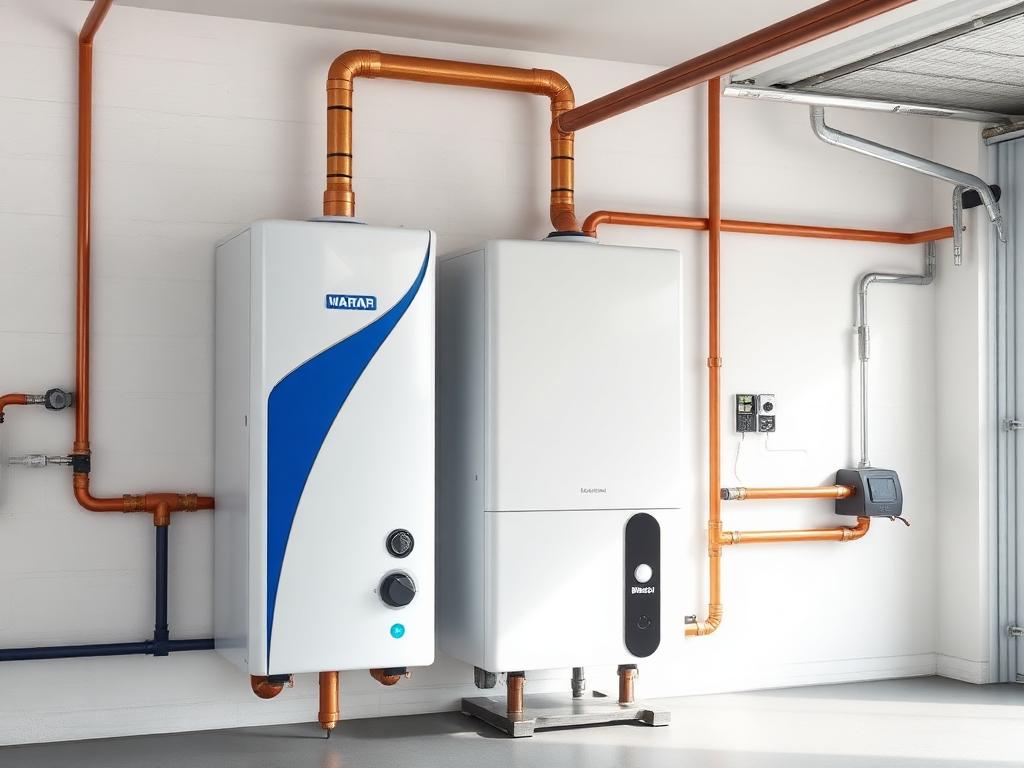
Heat Pump Water Heaters, Explained by the Installers
Refrigerant cycle physics, COP vs UEF, first-hour rating, 240V circuit sizing, ducting & air-volume rules, condensate management, PSE + IRA rebate stacking, and the install mistakes that quietly halve efficiency.
- 1. How a heat pump water heater works
- 2. COP vs UEF — the efficiency numbers that matter
- 3. Operating modes (Heat Pump / Hybrid / Electric)
- 4. First-hour rating & correct tank sizing
- 5. Interactive sizing worksheet
- 6. Ambient air — the PNW temperature story
- 7. Air volume, louvers & ducting strategy
- 8. 240V circuits, breakers & 120V retrofit units
- 9. Condensate volume, pan & drain code
- 10. Noise, vibration & garage placement
- 11. Refrigerants: R-134a, R-513A & R-290 (propane)
- 12. Puget Sound water chemistry & anode strategy
- 13. Recovery rate & why big families still love them
- 14. PSE rebates + IRA 25C tax credit stacking
- 15. ROI vs gas tank, electric tank & tankless
- 16. Brand notes: Rheem, A.O. Smith, Bradford White, State
- 17. Smart controls, demand response & TOU tariffs
- 18. Annual service, filter cleaning & lifespan
- 19. Cold garages & sub-40°F derating
- 20. 10 install mistakes we rip out and redo
How a heat pump water heater actually works
A heat pump water heater (HPWH) is not an electric water heater with extra parts. It's a small air-source heat pump — the same refrigerant cycle as a mini-split — mounted on top of an insulated storage tank. The cycle: a compressor pressurizes refrigerant vapor; the hot high-pressure vapor gives up its heat through a condenser coil wrapped around (or immersed in) the tank; the refrigerant condenses to a liquid, drops through an expansion valve, and expands back to a cold low-pressure vapor in the evaporator coil at the top of the unit; a fan pulls surrounding air across the evaporator, the refrigerant absorbs heat from that air, and the cycle repeats.
The consequence is that the electricity doesn't heat the water — it just moves heat from the surrounding air into the water. A resistance element inside the tank exists as a booster, but in Heat Pump mode it should almost never run. That's the origin of the 3–4× efficiency multiplier: for every 1 kWh of electricity the compressor consumes, roughly 3–4 kWh of heat is delivered to the tank.
Two side-effects of the cycle are structural and unavoidable: the room the unit sits in gets colder and drier (you're pulling heat and water vapor out of it), and the unit produces condensate that must be drained. Ignore either and the install is set up to fail.
COP vs UEF — the numbers that actually matter
Two efficiency ratings appear on every HPWH spec sheet, and they measure different things.
- COP (Coefficient of Performance): Instantaneous ratio of heat delivered to electrical input, at a specified ambient temperature. A COP of 3.5 at 67.5°F ambient means 3.5 kWh of heat out per 1 kWh in. COP is ambient-dependent — it climbs to 4.5+ at 80°F and drops to 2.0–2.5 at 45°F.
- UEF (Uniform Energy Factor): DOE test procedure result — an annualized efficiency over a standardized draw pattern, tested at 67.5°F ambient with 58°F inlet. A top-tier 50-gal HPWH scores UEF 3.7–4.0; the best 65 and 80-gal units score 3.5–3.9. A resistance tank scores 0.90–0.95. A gas tank scores 0.60–0.70.
Where installers get it wrong: comparing a HPWH's rated UEF (3.75) to a gas tank's rated UEF (0.65) and telling the customer "5.8× more efficient." That's true on the DOE test bench. In a 45°F Kirkland garage in January with an oversized draw pattern, the real-world COP might average 2.4 and the resistance element runs 20% of the time — real efficiency lands closer to 2.8×, not 5.8×. Still excellent, but "we'll cut your water heating bill 40–60%" is honest; "80%" is not.
- • 80°F ambient → COP ≈ 4.2
- • 67.5°F ambient (DOE) → COP ≈ 3.5
- • 55°F ambient → COP ≈ 2.9
- • 45°F ambient (typical Kirkland garage, winter) → COP ≈ 2.4
- • 35°F ambient → COP ≈ 2.0 (many units switch to hybrid or lock out compressor)
Heat Pump / Hybrid / Electric / Vacation — what to actually use
Every modern HPWH ships with four selectable modes. The label on the front panel matters:
- Heat Pump / Efficiency: Compressor only. Highest efficiency. Slowest recovery (~8 gallons per hour at 45°F ambient). Use this as the default for a right-sized 65 or 80-gal tank in a garage.
- Hybrid / Auto: Compressor plus resistance backup when demand exceeds compressor recovery. Best of both worlds for most 50-gal installs and any household of 4+.
- Electric / High Demand: Resistance elements only. Fastest recovery, worst efficiency (COP 1.0). Reserved for guests or a broken compressor — never as a permanent setting.
- Vacation: Holds ~60°F. Cuts standby loss to almost nothing while you're away. Undo at least 12 hours before returning.
Roughly half of underperformance complaints we investigate are units left in Hybrid or Electric mode from the day they were installed. On the day we commission, we set Heat Pump mode, verify recovery meets the household's draw pattern for a week, then adjust up to Hybrid only if needed.
First-hour rating (FHR) and why 'nominal gallons' lies
Tank capacity — 50, 65, 80 gal — is not the number that matters. First-hour rating (FHR) is: the DOE-measured amount of hot water the unit can deliver in one hour starting from a fully-heated tank, including whatever recovery happens during that hour.
| Household | Peak-hour demand | Recommended FHR | Typical unit |
|---|---|---|---|
| 1–2 people | ~34 gal | 45–55 gal FHR | 50-gal HPWH |
| 3 people | ~48 gal | 55–65 gal FHR | 50 or 65-gal |
| 4 people | ~62 gal | 65–75 gal FHR | 65 or 80-gal |
| 5+ people | ~78+ gal | 80+ gal FHR | 80-gal or cascade |
Peak-hour demand adds shower gallons (17 gal each) + bath (20 gal) + dishwasher (~6 gal hot) + laundry hot cycle (~7 gal) + kitchen prep (~5 gal) across your actual worst hour — typically 7–8 AM on a weekday.
A HPWH in Heat Pump-only mode recovers slower than a resistance tank (roughly 8–10 gal/hr vs 20 gal/hr), so you generally size up one tier compared to a resistance replacement: swap a 50-gal electric tank for a 65-gal HPWH; swap a 65 for an 80. Don't undersize and then blame the technology.
Sizing worksheet — get your recommended tank in 30 seconds
Punch in your household, and we'll estimate peak-hour demand, required first-hour rating, expected COP at your install location's ambient temperature, and a recommended tank size. Then talk to us for a real quote with the actual model, rebate stack, and install price.
Attached garage: ~55°F · Basement: ~62°F · Conditioned closet: ~68°F
Sized to meet ~90 gal in your worst hour with margin for a January cold snap.
Estimate only. A free in-home assessment confirms electrical capacity, install location air volume, condensate routing, and eligibility for the full PSE + IRA rebate stack.
Ambient air is the fuel — and the PNW is milder than you think
A HPWH's efficiency lives and dies by the air temperature at the evaporator. Puget Sound has a natural advantage: our garage temperatures rarely drop below the compressor lockout threshold (usually 37–40°F), and our summers rarely stress the upper limit.
- Kirkland/Bellevue attached garage (uninsulated door, one shared wall): 48–62°F year-round → COP 2.6–3.2
- Insulated garage or basement mechanical room: 55–70°F year-round → COP 3.0–3.8
- Conditioned laundry room or utility closet: 65–72°F → COP 3.5–4.0 (but see cooling penalty in §7)
- Detached / uninsulated garage: 38–58°F → compressor lockout risk in January cold snaps
For a Woodinville, Bothell, or foothills install in an uninsulated detached garage, we spec a 120V shared-circuit unit that stays in resistance-assist during cold weeks, or we relocate the unit to the basement.
Air volume, louvered doors, and duct kits
Manufacturers require 700–1,000 cubic feet of surrounding air space. Put a HPWH in a small closet and it will cool that closet down to compressor-lockout in three hours, then run on resistance-only forever. There are three code-compliant fixes:
- Free-air install (garage, unfinished basement): No ducting needed. Best efficiency, mild cooling of the room (a benefit in a garage).
- Louvered door install: For closets that open to a large adjacent space. Requires two grilles totaling ≥240 sq in of free area (top + bottom). Manufacturer sheets specify exact area — verify per unit.
- Duct kit: 8" round intake and exhaust ducts routed to unconditioned space, another room, or an exterior wall. Efficiency drops 5–10% from static pressure but the unit can live in a tight utility closet.
Putting a HPWH inside conditioned living space raises its COP (warmer air) but forces your gas furnace to reheat that same air in winter. In an all-electric home with a heat pump for space heating, the net efficiency is still positive (COP 3.5 water × COP 2.5 space ≈ neutral loss). In a gas-heated home, you're burning gas to feed the water heater — the math turns negative and it's better to duct the intake from the garage or an unconditioned attic.
240V dedicated circuit, breaker sizing, and the 120V retrofit alternative
The default install is a 240V, 30A dedicated circuit with #10 AWG copper. That runs both the compressor (~500W) and the two 4,500W resistance elements. Compressor-only draw is small; hybrid mode with resistance active is the load that sets the breaker.
- Standard 50–80 gal HPWH: 240V / 30A / #10 Cu / dedicated. Same circuit an electric tank uses.
- Gas-tank replacement: new circuit required. Panel-to-mechanical-room run, permit, inspection. Budget $600–$1,800 depending on distance and panel capacity.
- Panel full? Load-shed devices (DCC, NeoCharge) let a HPWH share a 240V circuit with a dryer or EV charger for ~$400 hardware — cheaper than a subpanel.
The 120V compressor-only alternative: Rheem's ProTerra Plug-In and A.O. Smith's Voltex 120V run on a standard 15A 120V outlet with no resistance backup. Recovery is slower (~4 gal/hr) so they need a bigger tank (80 gal minimum) and a household of ≤3 people. But they eliminate the electrical work entirely for a gas-tank swap — dramatically improving ROI on rebate-inclusive pricing.
Condensate volume, pans, drain lines & overflow protection
The evaporator pulls moisture out of the surrounding air. A HPWH in an Eastside garage produces roughly 3–8 gallons of condensate per week depending on humidity and use. That has to go somewhere gravity-friendly.
- Gravity drain: 3/4" PVC to a floor drain, laundry standpipe, or exterior downspout. Slope ≥1/8" per foot. Preferred.
- Condensate pump: Little Giant VCMA-15ULS or similar. Needed when the unit sits below the nearest drain. Wire the safety switch to shut the HPWH down on overflow.
- Drain pan: Required by IRC P2801.6 anywhere a leak would cause damage. Metal or plastic, 1-1/2" drain to daylight or a safe termination — not into the same PVC as the condensate.
- Leak sensor: We add a Moen Flo or Aquilar puck in the pan. Cheap insurance; ties into smart-home shutoff on high-value installs.
Unlike a condensing gas appliance, HPWH condensate is near-neutral pH (6.5–7.5) — it's just dehumidifier water. No neutralizer needed. You can legally drain to a laundry standpipe or into landscape irrigation in most WA jurisdictions; check locally for direct-to-storm-drain rules.
Noise, vibration & where not to put one
A modern HPWH runs at 45–55 dBA at 3 feet — quieter than a dishwasher, louder than a modern gas furnace. The sound has two components: the fan (a broadband whoosh) and the compressor (a low steady hum around 60–120 Hz that transmits through the floor).
- Garage/basement: essentially inaudible in the living space. Ideal.
- Utility closet next to a bedroom: problem. The compressor hum transmits through shared walls. Isolation pad + resilient channel or relocation are the options.
- Second-floor laundry: vibration transmits down. Always install on a vibration-isolation pad (cork/rubber, 3/4" minimum). Never bare on tile.
We hard-decline installs directly on the other side of a bedroom wall unless the customer accepts the acoustic trade-off in writing. It's the #1 source of post-install complaints across the industry.
R-134a, R-513A, and the R-290 (propane) future
Refrigerant chemistry is quietly transitioning under the AIM Act. What's in the tank on your driveway today matters for repairability and long-term serviceability.
- R-134a (older Rheem, A.O. Smith units): GWP 1,430. Being phased down; still fully serviceable, refrigerant available for years.
- R-513A (current ProTerra, Voltex, some SanCO2): GWP 631. Drop-in replacement chemistry, AIM Act compliant through 2028+.
- R-290 (propane) (Sanden SanCO2 competitors, some EU imports): GWP 3. Flammable — restricts charge to ≤150g, mandates specific ventilation. Best cold-climate performance; niche in US residential.
- CO2 (R-744) (SanCO2 split systems): GWP 1. Transcritical cycle, exceptional cold-climate COP, but split architecture with outdoor compressor — $8–12K installed. Rare in residential Eastside except high-performance retrofits.
For a straightforward Kirkland retrofit today, R-513A packaged units are the sweet spot.
Puget Sound water hardness & anode strategy
Kirkland, Bellevue, and most of the Cascade Water Alliance service area gets water from the Cedar and Tolt watersheds — very soft, 15–35 ppm total hardness and slightly acidic (pH 7.2–7.5). That's a mixed blessing:
- Excellent for scale — no mineral buildup on the wrapped condenser coil, so heat transfer stays high for 15+ years.
- Aggressive on the sacrificial anode rod — expect faster anode consumption than the national average. We inspect at year 3 and typically replace at year 5.
- Softened water (whole-house softener) halves anode life — swap the factory magnesium rod for an aluminum-zinc rod at install if a softener is present.
Powered/impressed-current anode rods (Corro-Protec) are worth the ~$180 upgrade on any 80-gal install in softened water — they eliminate anode replacement entirely and quiet the intermittent sulfur smell that hits ~1 in 8 installs.
Recovery rate: why big families still love a HPWH
The stereotype: "HPWHs recover slow, so they're only for small households." Half true, half wrong.
Recovery in Heat Pump-only mode at 65°F ambient is roughly 8–10 gal/hr. Recovery in Hybrid mode (both elements on) is 20–25 gal/hr — the same as a resistance tank. Recovery in Electric-only mode is 20–25 gal/hr.
A 5-person household with an 80-gal HPWH in Hybrid mode has 80 gal of stored capacity plus 22 gal/hr of recovery — that's a 145-gal-per-hour first-hour rating, more than a 75-gal gas tank. The efficiency during hybrid recovery is worse than heat-pump-only (blended COP ≈ 1.5), but that only happens during the morning surge; the other 20 hours a day it's running compressor-only at COP 3.0+.
The families that regret HPWHs are the ones sold a 50-gal unit for a household of 5. The families that love them get an 80-gal in Hybrid-auto mode and never think about it.
PSE + IRA 25C — stacking the incentives
As of 2026, Eastside customers can typically stack:
- PSE Heat Pump Water Heater rebate: $500–$1,000+ depending on tier and installation type (electric-tank swap vs gas-tank conversion). Gas-to-electric conversions get the higher tier. We file this.
- Federal IRA 25C tax credit: 30% of installed cost, capped at $2,000/year for HPWHs. Claimed on IRS Form 5695. Applies to equipment + labor + electrical work.
- WA HEAR rebate (income-qualified): Up to $1,750 for a HPWH for households under 150% of area median income, once the state rolls the DOE HEAR program (WA launched late 2025). Cannot be stacked with 25C on the same equipment — pick whichever is larger.
- City-level: Kirkland and Bellevue occasionally run climate-fund rebates (~$150–$500). We check current programs at quote time.
- • Equipment + labor + permit: $4,800
- • PSE rebate (electric-tank swap): −$500
- • IRA 25C tax credit (30% of $4,800): −$1,440
- • Net out-of-pocket: ~$2,860 — often less than a like-for-like resistance tank after rebates.
ROI: real numbers vs gas tank, electric tank, and tankless
Annual operating cost for a 4-person Eastside household, ~64 gal/day at PSE 2026 rates (electric ~$0.12/kWh, gas ~$1.35/therm):
| System | UEF | Annual energy cost | 15-yr operating cost |
|---|---|---|---|
| Gas storage tank | 0.65 | ~$310 | ~$5,200 |
| Condensing gas tankless | 0.93 | ~$220 | ~$3,700 |
| Electric resistance tank | 0.93 | ~$620 | ~$10,400 |
| HPWH (real-world blended) | ~2.8 | ~$210 | ~$3,500 |
Against a resistance tank, a HPWH saves ~$400/year — payback under 4 years even before rebates. Against a gas tank, it saves ~$100/year on operating cost, but the fuel-switch also removes a combustion appliance, reduces the home's carbon footprint by ~1.5 tons CO₂/yr, and future-proofs against gas rate increases and possible new-construction gas bans.
Brand notes: what we install and why
- Rheem ProTerra (Performance Platinum): Most-installed HPWH in the country. Wrapped condenser (not immersed), R-513A, EcoNet WiFi, 10-year warranty, real diagnostics via app. 120V plug-in variant available in 80-gal. Our default recommendation for gas-tank retrofits.
- A.O. Smith Voltex / Voltex AL: Excellent hardware, marginally quieter than Rheem, HydroBoost tank shape can fit tighter spaces. AL (Advanced Learning) model has better predictive scheduling. 10-year warranty. Strong choice, similar price.
- Bradford White AeroTherm: Contractor-only distribution, higher-quality build, longer real-world lifespan. No consumer WiFi app. We spec for customers who value reliability over connectivity.
- State Premier Hybrid Electric: A.O. Smith's sister brand — same guts, contractor-only channel, competitive pricing when Rheem stock is short.
- SanCO2 (split CO₂ HPWH): Outdoor compressor + indoor tank. Class-leading cold-climate COP (holds 3.0+ at 20°F). $8–12K installed. Overkill for most Eastside homes; ideal for high-performance retrofits and Passive House builds.
Brands we decline: any big-box exclusive labeled with a supplier name (Kenmore Elite, GE GeoSpring — discontinued anyway, cited here so you don't buy a used one on Craigslist). Warranty support and parts availability are the problem, not the hardware.
Demand response, TOU tariffs & scheduling
PSE offers demand response programs for connected HPWHs — the utility can briefly shift heating out of peak hours in exchange for a small annual bill credit ($25–$75). All major brands support the CTA-2045 standard or a proprietary equivalent via WiFi.
Time-of-use scheduling: if you're on PSE's TOU rate (or moving to one), schedule the compressor to run midnight–6am when rates are ~40% lower. Rheem and A.O. Smith apps do this natively. The stored 65–80 gal of hot water is a battery — you're arbitraging cheap overnight electricity against peak-hour rates.
Combined effect on our real installs: ~10–15% additional annual savings on top of the base efficiency win. Worth setting up on day one.
Annual service: filter, anode, T&P, and full inspection
- Every 6 months: Pull the intake air filter, rinse in warm water, dry, reinstall. A clogged filter drops COP by 15–25% and is the #1 cause of "the unit stopped saving me money."
- Annually: Flush 2–3 gallons through the drain valve to clear sediment. Test T&P valve. Inspect condensate line for algae. Verify anode inspection port is accessible (some models bury it).
- Year 3–5: Anode rod inspection and typically replacement (Puget Sound soft water eats them faster than the national average).
- Year 10: Evaluate whether to replace or continue. Modern HPWHs are trending toward 15-year lifespans with proper maintenance, vs 10–12 for a resistance tank.
Cold garages, compressor lockout & the derating problem
Every HPWH has a compressor lockout temperature — typically 37–42°F ambient. Below that, the unit refuses to run the compressor (evaporator would frost) and falls back to resistance-only mode. In an uninsulated detached garage in Snoqualmie or Sammamish, that can be 20+ days of resistance-only operation per winter.
Mitigations, from cheapest to most expensive:
- Insulate the garage door — the single highest-ROI change. Cheap, DIY-friendly, keeps the space 6–12°F warmer.
- Duct the intake to conditioned crawlspace or a heated laundry room — keeps the compressor happy without cooling the living space.
- Relocate the unit to a conditioned basement mechanical room. Best result, biggest install cost.
- Choose a SanCO2 split system — outdoor compressor is designed for freezing air. Overkill for most, right answer for foothill customers.
10 install mistakes we routinely rip out and redo
- Undersized 50-gal tank for a 4+ person household — chronic cold showers, blame lands on "the technology"
- Installed in a small closet without louvered door or duct kit — closet cools to lockout in hours
- Left in Electric or Hybrid-default mode at commissioning — customer pays resistance-tank rates forever
- Condensate line pitched wrong (uphill or level) — pan fills, safety switch trips, no hot water
- No drain pan on a second-floor install — water damage on first leak, insurance dispute
- Reused a corroded 40-year-old ball valve or dielectric union — leaks within a year
- Anode rod inspection port blocked by wall or ceiling — impossible to service without moving the tank
- Installed against an interior bedroom wall — compressor hum drives homeowner to demand relocation
- Undersized 240V wire (#12 on a 30A circuit) — heats under sustained hybrid mode, breaker nuisance-trips
- PSE rebate paperwork not filed at time of install — customer misses the deadline, forfeits $500–$1,000
Talk to installers who actually understand these units.
Free in-home assessment, honest sizing math, and full PSE rebate paperwork handled — Kirkland, Bellevue, Redmond, Bothell, Woodinville.