
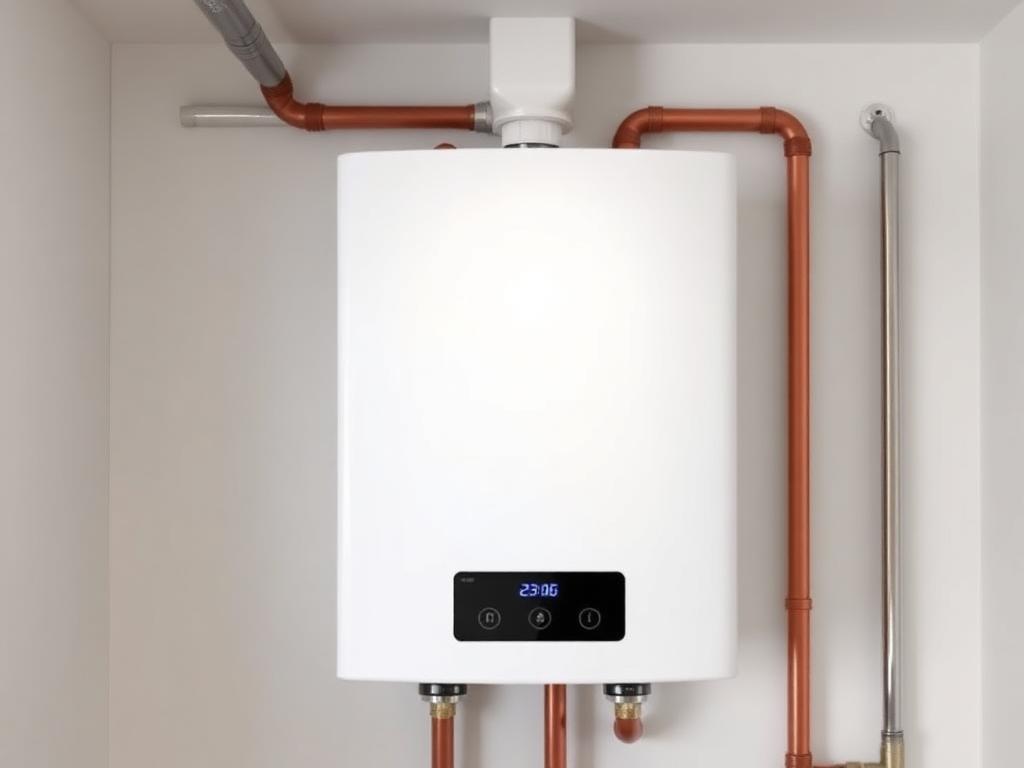
Tankless Water Heaters, Explained by the Installers
Sizing math, combustion physics, gas supply, Category IV venting, condensate chemistry, recirculation strategy, error-code diagnostics, and Puget Sound water — the details that decide whether a tankless install lasts 6 months or 25 years.
- 1. How a tankless unit actually works
- 2. Condensing vs non-condensing (95% vs 82% EF)
- 3. Heat-exchanger metallurgy & why it matters
- 4. Sizing: GPM, temp rise & BTU math
- 5. Pacific NW inlet temps break generic charts
- 6. Interactive sizing worksheet
- 6. Modulation ratio & minimum flow
- 7. Gas line sizing & PSE meter capacity
- 8. Category IV venting & clearances
- 9. Condensate pH, neutralization & drainage
- 10. Puget Sound water chemistry & scale
- 11. Cold-water sandwich (and how to kill it)
- 12. Recirculation: dedicated loop vs crossover
- 13. Cascading & manifolding for large homes
- 14. Electric tankless — when it makes sense
- 15. Seismic strapping, expansion & code
- 16. Common error codes & what they mean
- 17. Annual service & lifespan
- 18. ROI: real numbers vs a 50-gal tank
- 19. Brand notes: Rinnai / Navien / Noritz
- 20. 10 install mistakes we rip out and redo
How a tankless unit actually works
A tankless (on-demand) water heater has zero storage. A flow sensor sees water moving above a minimum threshold — typically 0.4–0.5 GPM — and signals the controller. A spark or hot-surface igniter lights the burner, a variable-speed premix fan pulls combustion air, and a modulating gas valve ramps firing rate from roughly 15,000 BTU/hr at idle up to 199,000 BTU/hr at full input. Water passes through a finned heat exchanger and exits at a target setpoint typically within 2 seconds.
Two consequences follow. First, output is rate-limited, not volume-limited: the unit can fire indefinitely, but only at whatever GPM it can raise to setpoint. Run a demand it can't meet and it either drops the outlet temperature or throttles flow (via an internal bypass or by relying on your fixture mixer). Second, standby losses are eliminated — a 50-gallon tank loses roughly 3–5% of its heat per day just sitting there. That's the origin of the 24–34% efficiency delta you see in Energy Factor (EF) or Uniform Energy Factor (UEF) ratings.
What that means practically: correct sizing and gas supply matter far more on a tankless than on a tank. A tank forgives an undersized burner by simply taking longer to recover. A tankless doesn't — it delivers what it can deliver right now, and the shortfall shows up as a lukewarm shower.
Condensing vs non-condensing — the 95% vs 82% split
Every gas tankless falls into one of two categories:
- Non-condensing (82–85% EF): Single heat exchanger, typically copper. Flue gas exits at 300–400°F and vents through stainless Category III piping. Cheaper unit, more expensive venting.
- Condensing (93–97% EF): Primary copper HX plus a secondary stainless-steel HX that scavenges latent heat from the flue gas by cooling it below the dew point (~130°F). Flue exits at 100–110°F and vents through PVC/CPVC/polypropylene — inexpensive, easy to route. More expensive unit, cheaper venting, more efficient.
For a new Eastside install we almost always specify condensing. The efficiency delta (roughly 12 percentage points) recovers the unit's price premium in 4–7 years of gas savings, and PVC venting lets us terminate through a rim joist or wall penetration that would be impossible with Cat III stainless. Non-condensing still has a role — replacing an existing non-condensing unit in a mechanical room already piped for Cat III — but as a first-time tankless conversion it rarely pencils out.
Heat-exchanger metallurgy (and why brand marketing hides it)
Every failed tankless we replace under 10 years old failed at the heat exchanger. Materials matter:
- Copper primary HX: Excellent thermal conductivity (~400 W/m·K), industry standard. Vulnerable to acidic condensate contact and to erosion from high-velocity flow. Requires clean combustion and correct water pH.
- Stainless secondary HX (condensing): Usually 316L or 439. 316L is more corrosion-resistant against acidic condensate but costs more; 439 is cheaper and more common in mid-tier units. Ask which one is in the unit you're being sold.
- Dual stainless (Navien NPE-2 series, some Rinnai commercial): Both primary and secondary in stainless. Longest heat-exchanger life in hard-water or high-cycling applications, but slightly lower peak efficiency than copper primary.
None of this appears on the yard sign at a big-box store. The warranty length is a decent proxy — a 15-year heat-exchanger warranty tells you the manufacturer trusts the metallurgy; a 10-year warranty on a "premium" unit does not.
GPM, temperature rise, and BTU math you can actually check
Every tankless spec sheet quotes GPM "at a given temperature rise." A 199k BTU condensing unit typically publishes:
| Temperature rise | GPM (199k BTU condensing) | Typical scenario |
|---|---|---|
| 35°F | ~11.1 | Southern US, summer |
| 45°F | ~8.6 | US average |
| 65°F | ~6.0 | Puget Sound, winter |
| 77°F | ~5.0 | Cold snap, well water |
The physics is simple: GPM = BTU/hr ÷ (500 × ΔT × combustion efficiency). For a 199,000 BTU unit at 95% efficiency and a 65°F rise: 199,000 × 0.95 ÷ (500 × 65) ≈ 5.8 GPM. That matches the manufacturer chart.
- • Low-flow shower: 1.5–2.0 GPM · Standard shower: 2.5 GPM · Rain head or body sprays: 3.0–5.0 GPM
- • Kitchen faucet: 1.0–1.5 GPM · Lav faucet: 0.5–1.0 GPM · Tub filler: 4.0–8.0 GPM
- • Dishwasher (hot fill): 1.0 GPM · Clothes washer (hot fill): 1.5–2.0 GPM
- • Design target at fixture: 115–120°F
A typical Eastside home with two simultaneous showers plus a kitchen tap needs ~6.0 GPM at a 65–70°F rise. That's a 180–199k BTU condensing unit — not the 150k model a big-box store will spec off a household head count.
Why Pacific Northwest inlet temps break generic sizing charts
Manufacturers publish GPM at a 35°F or 45°F rise because that's the U.S. average. In Kirkland, Bellevue, and most of King County, winter groundwater enters the house at 45–50°F — Cedar River Watershed and Tolt supply averages around 45°F December through February. To deliver a 115°F shower you need a 65–70°F rise, which cuts published GPM roughly in half compared to the marketing number.
This is why homes that swap a 50-gallon tank for an "equivalent" 150k BTU tankless end up with lukewarm second showers in January. Correct sizing here almost always means a 180k or 199k condensing unit, and for homes over roughly 4,500 sq ft with 3+ full baths, a cascaded pair in parallel.
Size your tankless in 60 seconds
Estimate the fixtures that could realistically run at the same time — a busy weekday morning, or a full-house scenario. We'll compute the peak GPM and BTU your home needs at Pacific NW inlet temps, then recommend a unit class. This is the same math we run on-site before quoting.
Puget Sound winter ~47°F, summer ~58°F.
120°F is code default and safest.
Condensing = default for new installs.
Based on 4.0 GPM × 500 × 73°F ÷ 0.95. Real-world sizing also accounts for gas line capacity, vent path, and recirculation load — that's the free in-home assessment.
Estimate only. Final sizing requires on-site verification of gas supply, meter capacity, vent path, water chemistry, and recirculation demand.
Modulation ratio and minimum flow — the low-demand problem
Sizing is not only about the top end. Every tankless has a minimum firing rate (often 15,000–19,000 BTU/hr) and a minimum activation flow (0.4–0.5 GPM). A 199k BTU unit with a 15k floor has a 13:1 modulation ratio.
Why this matters: at a hand-washing trickle (0.3 GPM), the flow sensor never triggers and you get cold water. At a bathroom faucet running at 0.6 GPM with a 65°F rise, the unit fires at its minimum and overshoots — pumping in more heat than the water can absorb — then modulates down or short-cycles. This is the source of the "warm-cold-warm" complaint on lav faucets.
Fixes: aerators sized at 1.0 GPM instead of 0.5, buffer tanks on large recirculating systems, and picking units with wider turndown (Navien NPE-A2 series and Rinnai Sensei RX are class-leading here at ~15:1).
Gas line sizing & PSE meter capacity
A 199k BTU tankless burns roughly 4× the peak gas of a 40k BTU tank heater. The existing 1/2" branch and standard 250 CFH residential meter that fed your old tank is rarely enough once you add furnace, range, and dryer running simultaneously.
Sizing follows NFPA 54 (National Fuel Gas Code) Table 6.2(a) for Schedule 40 black iron. Key numbers at 0.5" WC pressure drop, natural gas, on a 40-foot run:
- 1/2" pipe: ~63 CFH — nowhere near enough (199k BTU ≈ 199 CFH)
- 3/4" pipe: ~132 CFH — insufficient at 40 ft, marginal at 20 ft
- 1" pipe: ~248 CFH — correct for most single-unit installs
- 1-1/4" pipe: ~509 CFH — needed for cascaded pairs or long runs
CSST (yellow or black flexible line, TracPipe / Gastite) has its own smaller tables — a nominal 1" CSST typically flows less than a 3/4" black iron run of the same length. Never up-size by eyeball. Always do the developed-length calc from the meter.
Puget Sound Energy provides free residential meter upsizes when total connected load exceeds meter capacity. Standard 250 CFH → 425 CFH is the most common upgrade for a tankless conversion; it requires a submitted load calc (furnace + range + dryer + water heater + fireplace) and typically completes in 2–4 weeks. We file this on your behalf when needed.
Category IV venting, concentric runs, and clearances
Modern condensing tankless units are Category IV appliances — flue gas exits cool and wet under positive pressure. That constrains materials and installation:
- Vent material: schedule 40 PVC, CPVC, or polypropylene (PP) rated to the manufacturer's spec. Never galvanized B-vent, never single-wall stainless.
- All joints solvent-welded (PVC/CPVC) or gasketed (PP). Slope back to the unit at ≥1/4" per foot so condensate drains back to the internal trap, not out the termination.
- Max equivalent length typically 65–100 ft for 3" pipe; every 90° elbow counts as ~5 ft. Long horizontal runs need supports every 4 ft to prevent sag pockets.
- Concentric vent kits (intake + exhaust nested in one pipe) allow a single 3" or 4" wall penetration and eliminate short-circuit risk. Preferred for wall terminations.
Termination clearances (IRC / IFGC 2021 with WA state amendments):
- • ≥12" above finished grade or the design snow line — 18–24" is safer in Woodinville / Sammamish plateau installs.
- • ≥4 ft below, and ≥1 ft above or horizontally from any window, door, or gravity air intake.
- • ≥3 ft from a forced-air inlet within 10 ft.
- • ≥12" from any inside corner formed by two building walls (recirculation zone).
- • Never under a soffit, deck, or overhang unless the manufacturer explicitly permits it — most don't.
Re-using the old tank's B-vent for a condensing tankless. B-vent is Category I — designed for hot, dry, negatively-pressured flue gas. Condensing flue is acidic and cool; it will corrode the B-vent from the inside within 12–18 months and leak flue gas into the attic or wall cavity. If you see a tankless connected to a metal chimney, it's wrong.
Condensate: pH, neutralization, and where to drain it
A condensing tankless firing at 199k BTU produces roughly 0.8–1.0 gallons of condensate per hour of full-fire operation. That condensate is carbonic and nitric acid at pH 3.0–4.5 — comparable to vinegar or lemon juice.
Dumping that directly into copper waste piping, cast-iron stack, or a galvanized floor drain will etch the pipe wall measurably within 3–5 years. Correct practice:
- Route condensate through a neutralizer cartridge — inline PVC housing filled with calcium carbonate / magnesium oxide chips. Raises pH to 6.5–7.5.
- Media life: 12–24 months in typical residential use. Inspect annually; replace when the media is visibly reduced or effluent pH drops below 5.5.
- Gravity-drain to a nearby laundry standpipe, floor drain, or lav trap arm — always with an air gap, never a direct connection.
- If gravity isn't available, use a condensate lift pump (Little Giant VCMA-15 class) with a safety float that shuts down the heater on overflow.
Skip the neutralizer to save $60 and you'll be replacing waste pipe for $4,000–$8,000 within a decade.
Puget Sound water chemistry & scale
Seattle Public Utilities and Cascade Water Alliance (which serves most Eastside cities) draw from the Cedar River, South Fork Tolt, and Chester Morse Lake watersheds. Typical delivered water is:
- • Hardness: 15–40 mg/L as CaCO₃ (about 1–2.5 grains/gal — "soft" by any standard)
- • pH: 7.8–8.2 (post-treatment; raised with lime for corrosion control)
- • Alkalinity: 15–25 mg/L
- • Free chlorine: 0.5–1.5 mg/L
That's genuinely favorable water for a tankless — most of North America runs 5–15+ grains/gal and scales heat exchangers aggressively. But well water on the Sammamish plateau, Cottage Lake, and pockets of Woodinville / Duvall can run 8–20 grains/gal with elevated iron. On well water we specify a Scalewatcher or template-assisted crystallization (TAC) unit upstream of the heater and shorten descale intervals to 6 months.
Calcium carbonate solubility drops as temperature rises. Above ~140°F, dissolved CaCO₃ falls out of solution and plates onto the hottest surface in the system — which is the heat-exchanger tube wall. A 1 mm scale layer reduces thermal transfer by ~15% and forces the burner to fire longer for the same output, accelerating the failure it caused. Keep setpoint at 120°F (not 140°F) whenever the application allows.
The cold-water sandwich (and how to eliminate it)
You turn on the shower, hot water arrives, you shut the valve for 20 seconds to soap up, turn it back on — and get a 3-second slug of cold water in the middle. That's a cold-water sandwich: hot water from the last event sits in the supply pipe, then cold water pushed behind it by the shut-off arrives at the fixture before the tankless has re-ignited and pushed a new hot slug through.
Mitigations, in order of effectiveness:
- Recirculation with a demand pump (see next section) — keeps hot water at the fixture; sandwich effectively disappears.
- Internal buffer tank — Navien NPE-A2 series and Rinnai RSC models include a small (0.5–1 gal) internal tank that absorbs the sandwich.
- Higher setpoint plus fixture mixer — set 125–130°F at the unit so the sandwich is warm, not cold, then mix down at the fixture. Reduces severity, doesn't remove it.
Recirculation: dedicated loop vs. crossover, and pump control
Tankless units take 8–20 seconds to fire and push hot water to the fixture. In large homes with long runs to the master bath, that's a real comfort problem and a real water-waste problem — Sammamish and Woodinville lots often have 60+ feet of pipe between the utility room and the primary suite.
Best-in-class. A 1/2" or 3/4" return line runs from the farthest fixture back to a dedicated port on the heater. Circulator (Grundfos UP15-10 class) pushes hot water around the loop on schedule or on demand. Near-instant hot water, zero waste, minimum sandwich. Ideal in new construction; retrofit only when walls or crawlspace access allows.
Retrofit-friendly. A thermostatic valve under the farthest sink connects the hot line to the cold line when the hot line has cooled. The pump inside the tankless (or an add-on) pushes water through the hot line, over the bridge, and back down the cold line to the heater. No new piping. Slight cold-line preheat and slightly lower efficiency than a dedicated loop, but ~90% of the benefit at 20% of the cost.
Pump control matters more than pump choice. Running the recirc 24/7 will erase the efficiency gain that made you switch. Use one of:
- • Schedule: 6–9 AM and 5–10 PM. Simple, effective, ~85% water/gas savings vs. continuous.
- • On-demand button at each remote fixture — press before entering the shower.
- • Learning mode (Rinnai Smart Circ, Navien HotButton with Comfort Flow) — the controller learns your usage pattern over 7 days and pre-heats only when you're likely to draw.
Cascading & manifolding for large homes
A single 199k BTU unit tops out at ~6 GPM in Puget Sound winter conditions. Homes over 4,500 sq ft with 3+ full baths, a soaking tub, or body-spray showers routinely exceed that. Two options:
- Cascaded pair (link kit): Two identical units wired together with a manufacturer link cable share load and rotate lead/lag. Delivers ~12 GPM at 65°F rise, redundancy if one fails, and both units cycle less. Requires 1-1/4" gas trunk and a common vent manifold. Our default for large homes.
- Zoned pairs: Separate units serving separate zones (e.g., one for master + kitchen, one for kids' baths + laundry). Simpler venting, no link kit, but each unit sees full demand within its zone.
Manifolded systems can scale to 4+ units for light commercial (small hotels, gyms). Beyond that, look at a commercial condensing boiler with an indirect tank.
Electric tankless — when it makes sense (and when it doesn't)
Whole-house electric tankless units (Stiebel Eltron Tempra 36 Plus, EcoSmart ECO 36, Rheem RTEX-36) draw 150 amps at full load — three 50-amp double-pole breakers. Most Eastside homes have a 200A panel already allocated to a heat pump, EV charger, induction range, and dryer. Adding a whole-house electric tankless typically means a 200A → 400A service upgrade at $6,000–$12,000 plus panel work — which erases any price advantage vs. gas tankless or a heat pump water heater.
Electric tankless is the right answer for:
- A detached ADU, workshop, or pool bath where running gas isn't practical.
- A remote bathroom addition far from the main heater (point-of-use unit at 3–8 kW, single 30A circuit).
- A kitchen prep sink or bar sink with sporadic demand.
For whole-house replacement, gas tankless or a heat pump water heater almost always wins.
Seismic strapping, expansion tanks & King County code
Washington is a Seismic Design Category D region. Every water heater — tank or tankless — requires code-compliant seismic restraint. For tankless specifically:
- Wall-mounted units must be lag-bolted through the manufacturer's mounting bracket into studs, not just drywall. Toggle bolts or drywall anchors fail inspection.
- Gas connection uses a listed appliance connector with a full-port shut-off within 6 ft.
- Water hammer arrestors on nearby quick-closing valves (dishwasher, washing machine solenoids) reduce shock loads on the tankless heat exchanger.
- A thermal expansion tank is required whenever a check valve, pressure-reducing valve, or backflow preventer is on the main supply — which is now standard on almost all Eastside meters. Sized for 2 gallons on a typical residential system.
- Sediment trap (drip leg) on the gas supply, upstream of the appliance valve. Cheap, universally missed on DIY installs.
Common error codes and what they actually mean
Most tankless failures throw a code before they fail hard. Reading them saves diagnostic time. The most common in Puget Sound service calls:
| Code (Rinnai / Navien) | Root cause | Fix |
|---|---|---|
| 11 / E003 | No ignition | Gas valve off, undersized line, air in line after service |
| 12 / E004 | Flame loss mid-cycle | Vent recirculation, dirty flame rod, insufficient gas pressure under load |
| 14 / E016 | Overheat / thermal fuse | Scale buildup — descale required |
| 16 / E040 | Outlet temperature high | Bypass valve stuck, mixing valve failed |
| 61 / E109 | Combustion fan fault | Blocked intake screen, insect nest, fan bearing |
| 71 / E003 | Gas solenoid fault | Coil failure or wiring — service call |
| 99 / E351 | Vent blockage | Terminal screen iced, condensate freezing in horizontal run |
Recurring E016 or "LC" (Rinnai lime/scale warning) means descale was skipped for too long. Recurring E109 in winter almost always means the vent terminal froze — usually because the horizontal run doesn't slope enough or the terminal is under an eave.
Annual service & why it doubles lifespan
Skipped maintenance is the #1 cause of premature tankless failure. Puget Sound water is favorable, but not scale-free — every unit still needs annual attention:
- Descale flush — food-grade citric acid (preferred) or white vinegar through service (isolation) valves for 45–60 minutes, followed by fresh-water flush. Restores heat-exchanger efficiency, extends life to 20+ years.
- Inlet screen — pull, rinse, reinstall. Blocked screen causes low-flow and no-ignition faults.
- Air intake filter — vacuum every 6 months, replace annually. Common failure point in utility rooms shared with a clothes dryer or in dusty crawlspaces.
- Condensate neutralizer media — inspect annually, replace at 12–24 months or when effluent pH drops below 5.5.
- Combustion analysis — measure O₂, CO, and stack temp every 2 years. Confirms burner is tuned and vent is clear.
- Firmware / control-board updates — Navien and Rinnai push meaningful firmware updates. We check version at every visit.
Every unit we install includes full-port isolation valves and a first-year descale at no charge. Our annual service program covers all of the above at a flat rate.
ROI vs a standard 50-gallon tank — real numbers
The pitch is "endless hot water and lower bills." The bills part depends on details. Rough numbers for an Eastside home using 60 gallons/day at 120°F setpoint, PSE gas at $1.35/therm:
| Standard 50-gal (0.60 UEF) | Condensing tankless (0.95 UEF) | |
|---|---|---|
| Annual gas use | ~230 therms | ~145 therms |
| Annual gas cost | $310 | $195 |
| Annual savings | — | $115 |
| Install price (typical retrofit) | $2,800–$3,800 | $5,500–$8,500 |
| Expected lifespan | 10–12 yrs | 20–25 yrs (with descaling) |
| Simple payback (energy only) | — | 18–35 yrs |
| Payback incl. one avoided tank replacement | — | 8–14 yrs |
Read that honestly: on energy alone, tankless doesn't pay back inside its warranty. The real financial case is avoiding the second tank replacement, plus reclaiming utility-room floor space, plus the comfort case (endless hot water, no dead tank on Christmas morning). If you're replacing a healthy tank purely to save on gas, the math doesn't support it. If you're already facing a tank replacement, tankless is often the right long-run choice.
Brand notes — Rinnai, Navien, Noritz (what we install and why)
- Rinnai Sensei RX / RSC series — Japanese-built, best build quality we handle, quietest operation, best parts availability in the PNW. RSC199iN is our default for 3–4 bath Eastside homes. Slight premium; earns it. 15-yr HX warranty on registered units.
- Navien NPE-A2 / NPE-S2 series — Korean-built, built-in recirc pump and buffer tank on A2 (kills the cold-water sandwich without external pump), best turndown ratio in class, strong app integration. NPE240A2 is our go-to when the customer wants smart controls and recirc without the extra piping.
- Noritz NRCP / EZ series — Japanese-built, excellent commercial pedigree, EZ series is engineered specifically for tank-replacement retrofits (fits existing gas & vent penetrations on many jobs). Under-marketed but genuinely well-engineered.
- Rheem RTGH / Bradford White Infiniti — Fine mid-tier units. We service them, but for new installs we prefer the three above for parts availability and long-term serviceability in this region.
- Big-box store brands (various rebranded units) — Often the same manufacturer with a different faceplate and a shorter warranty. Parts and warranty support are worse. We do not install these.
10 install mistakes we regularly rip out and redo
- Undersized gas line — the unit fires, then throttles and error-codes when the furnace kicks on.
- Reused B-vent — corrodes, leaks flue gas, fails inspection within 18 months.
- No isolation valves — descaling requires cutting pipe. $300 part left off to save $80 kills future serviceability.
- Condensate straight to drain — acidic discharge dissolves copper and cast-iron waste lines.
- Wrong-model sizing — 150k unit installed where 199k was needed; second shower goes cold in January.
- Vent terminated under an eave, deck, or too close to a window — flue recirculates, unit locks out on lean combustion or CO ingress.
- Recirc pump wired to run 24/7 — annual gas bill goes up, not down. Needs a schedule, on-demand button, or learning mode.
- No thermal expansion tank — every closed system in King County needs one; T&P valve weeps and gets blamed on the heater.
- Toggle-bolt wall mount — fails seismic inspection, fails after one solid earthquake. Must lag into studs.
- No sediment trap on the gas line — small debris from pipe cutting or CSST installation lands in the gas valve and kills it within a year.
Expert tankless install across the Eastside
We install, cascade, retrofit, and service tankless water heaters throughout our 30-mile radius from Kirkland. See tankless service details for your city:
- Tankless service in Kirkland →
- Tankless service in Bellevue →
- Tankless service in Redmond →
- Tankless service in Bothell →
- Tankless service in Woodinville →
- Tankless service in Sammamish →
- Tankless service in Kenmore →
- Tankless service in Mercer Island →
- Tankless service in Issaquah →
- Tankless service in Lynnwood →
Want a tankless install done right the first time?
Free in-home assessment with gas load calc, vent path review, water chemistry check, and a flat-rate written quote — no upsells.